Optimizing HSS Tool Bit Production: Advanced Eco-Friendly Descaling Solutions for High-Precision Tool Steel Manufacturing
Case Study-2
- Home
- Case Studies
- Optimizing HSS Tool Bit Production: Advanced Eco-Friendly Descaling Solutions for High- Precision Tool Steel Manufacturing
Optimizing HSS Tool Bit Production: Advanced Eco-Friendly Descaling Solutions for High-Precision Tool Steel Manufacturing
Executive Summary & Overview:
High-Speed Steel (HSS) tool bits represent a critical baseline in precision machining, metalworking, and industrial manufacturing. Engineered to sustain extreme temperatures without losing structural hardness, these high-performance cutting tools undergo rigorous metallurgical processes, including intense heat treatment cycles. However, high-temperature thermal hardening creates an unavoidable by product: a stubborn, tightly bonded oxide scale layer that coats the entire workpiece surface.
Traditionally, manufacturers have relied on aggressive chemical pickling—utilizing harsh mineral acids such as hydrochloric acid (HCl), sulphuric acid, or hydrofluoric acid—or abrasive mechanical shot blasting to remove post-heat-treatment thermal oxides. While these conventional techniques clean the metal surface, they introduce severe operational liabilities. Acid pickling generates corrosive toxic fumes, poses severe occupational hazards to shop floor technicians, damages processing tanks through acid corrosion, and generates substantial volumes of regulated toxic chemical effluent. On the other hand, abrasive mechanical methods often induce surface roughness, distort fine cutting edges, and fail to clean intricate internal geometry or narrow flutes.
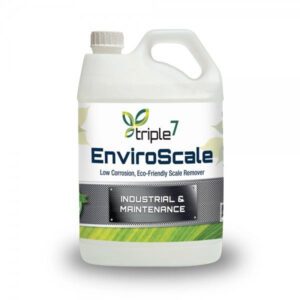
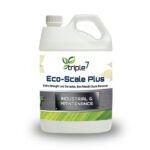
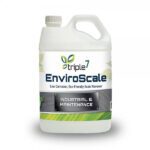
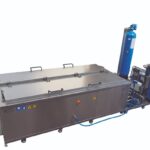
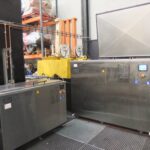
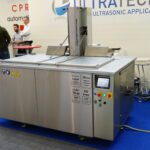
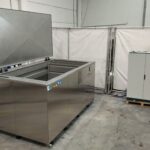
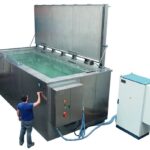
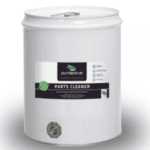
To solve these multi-faceted challenges, a leading tool bit manufacturer partnered with Evergreen Solution to overhaul its post-heat-treatment cleaning line. By pairing Triple7 Enviroscale Plus—a specialized organic, bio-based descaling chemistry—with high-power industrial ultrasonic cleaning baths, the manufacturer achieved complete oxide removal, eliminated hazardous acid handling, drastically slashed fluid disposal overhead, and established a fully repeatable, ESG-compliant surface finishing workflow.
Metallurgy of High-Speed Steel Cutting Tools:
High-Speed Steel tools are forged from complex steel alloys enriched with tungsten, molybdenum, chromium, vanadium, and cobalt. These alloying elements allow HSS tool bits to maintain high hardness (often exceeding 60–65 HRC) even under severe friction and heat generated during heavy machining operations. Achieving these mechanical properties requires subjecting raw tool bits to high-temperature furnace hardening (often exceeding 1,000°C) followed by targeted tempering cycles.
The Physics of Heat-Treatment Oxide Scale Formation:
When steel components are exposed to elevated furnace temperatures, atmospheric oxygen reacts rapidly with surface iron and alloying elements. This oxidation creates a heavy, multi-layered oxide crust (primarily composed of hematite, magnetite, and wüstite):
Oxidation Reaction: 3Fe + 2O2 ⟶Fe3O4
This thermal scale layer exhibits strong adhesive bonds with the underlying steel substrate. If this surface oxide is not completely cleared before downstream processing, several catastrophic quality failures occur:
Dimensional Non-Conformance: Uncontrolled scale thickness distorts micro-tolerances required for precision cutting applications.
PVD/CVD Coating Failure: Modern cutting tools are frequently coated with Physical Vapor Deposition (PVD) compounds such as Titanium Nitride (TiN) or Titanium Aluminium Nitride (TiAlN). Oxide scale acts as a barrier, causing severe coating flaking and adhesion failure.
Premature Tool Wear: Trapped surface scale particles detach during machining, causing premature tool chipping and erratic tool wear patterns.
The Hidden Operational Costs of Acid Pickling:
For decades, mineral acid pickling served as the default descaling method across metalworking facilities. However, modern environmental regulations and Environmental Health & Safety (EHS) mandates have highlighted the severe drawbacks of traditional acid washing:
+---------------------------+-----------------------------+--------------------------------+
|                             TRADITIONAL DESCALING DRAWBACKS                              |
+---------------------------+-----------------------------+--------------------------------+
| WORKER SAFETY RISKS       | ASSET CORROSION RISKS       | ENVIRONMENTAL IMPACTS          |
+---------------------------+-----------------------------+--------------------------------+
| • Corrosive burns & fumes | • Micro-pitting on steel    | • High effluent neutralization |
| • Respiratory hazards     | • Hydrogen embrittlement    | • Toxic sludge handling        |
| • Hazardous PPE burden    | • Plant structural damage   | • Strict discharge fees        |
+---------------------------+-----------------------------+--------------------------------+
Furthermore, aggressive mineral acids often lead to hydrogen embrittlement, where hydrogen ions penetrate the crystal lattice of hardened tool steel, causing micro-cracking and catastrophic tool failure under heavy structural loads.
Technical Solution: Organic Bio-Based Chemistry & Ultrasonic Synergy
Recognizing that conventional chemical and mechanical approaches were insufficient for sustainable high-volume manufacturing, Evergreen Solution developed an integrated descaling system that combines bio-based chemical surfactants with physical ultrasonic energy.
                +----------------------------------------------+
                |            ECO-FRIENDLY DESCALING            |
                |                   FRAMEWORK                  |
                +----------------------+-----------------------+
                                       |
               +-----------------------+-----------------------+
               |                                               |
               v                                               v
+-----------------------------+                 +-----------------------------+
|  TRIPLE7 ENVIROSCALE PLUS   |                 |    INDUSTRIAL ULTRASONIC    |
|    CHEMISTRY (CHEMICAL)     |                 |    AGITATION (PHYSICAL)     |
+-----------------------------+                 +-----------------------------+
| • Non-corrosive, organic    |                 | • Cavitation micro-jets     |
| • Penetrates micro-fissures |                 | • Dislodges bound oxides    |
| • Prevents flash rusting    |                 | • Reaches complex geometries|
+-----------------------------+                 +-----------------------------+
1. Organic Bio-Based Descaling Chemistry (Triple7 Enviroscale Plus):
The foundation of the solution is Triple7 Enviro scale Plus, an advanced bio-based descaling chemistry designed to lift complex mineral scales, heavy oxidation, and heat-treatment oxides without etching base metal alloys.
Targeted Oxide Cleavage: Unlike non-selective mineral acids that attack raw metal and oxide indiscriminately, Triple7 Enviro scale Plus selectively reacts with surface oxides, loosening scale bonds at the molecular interface.
Non-Corrosive Profile: Formulated without harsh inorganic acids (hydrochloric, hydrofluoric, sulphuric, or nitric acids), preventing metal loss, pitting, or hydrogen embrittlement.
Enhanced Workplace Safety: Zero volatile organic compounds (VOCs), zero toxic fumes, and non-flammable properties eliminate the requirement for expensive fume extraction systems and full-body hazmat suits.
Environmental Compatibility: Derived from readily biodegradable organic compounds, simplifying waste treatment and supporting zero-landfill corporate objectives.
2. High-Power Ultrasonic Cavitation:
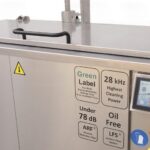
To accelerate chemical penetration into complex geometries, flutes, and micro-grooves, the bio-based descaling bath was integrated with high-power industrial ultrasonic transducers. Transducers convert electrical energy into high-frequency acoustic sound waves within the liquid bath (typically 25 kHz to 40 kHz).
These acoustic waves create alternating pressure cycles that generate millions of microscopic vapor cavities per second—a phenomenon known as ultrasonic cavitation.
When these micro-bubbles collapse near the workpiece surface, they generate micro- jets of localized fluid velocity that physically break apart loosened oxide scale, stripping it away from fine cutting edges without abrasive damage.
Step-by-Step Production Process & Implementation Workflow
Transitioning from an acid pickling process to an eco-friendly ultrasonic descaling system required careful tuning of bath temperature, chemical concentration, exposure time, and post-wash handling.
+------------------------------------------------------------------------------------+
|                           PRODUCTION DESCALING WORKFLOW                            |
+------------------------------------------------------------------------------------+
|                                                                                    |
|  [STEP 1: BATCH LOADING]                                                           |
|  • HSS tool bits placed into specialized stainless steel mesh baskets              |
|                                                                                    |
|  [STEP 2: ULTRASONIC DESCALING]                                                    |
|  • Submersion in Triple7 Enviroscale Plus bath (50°C - 60°C)                       |
|  • 28–40 kHz ultrasonic agitation dislodges stubborn heat-treatment scale          |
|                                                                                    |
|  [STEP 3: MULTI-STAGE RINSING]                                                     |
|  • Deionized water rinse removes dislodged scale particles and residual chemistry  |
|                                                                                    |
|  [STEP 4: FLASH RUST PREVENTION & DRYING]                                          |
|  • Built-in corrosion inhibitors protect pristine surface during forced-air dry    |
|                                                                                    |
+------------------------------------------------------------------------------------+
Detailed Operational Stages
Stage 1: Batch Loading & Basket Optimization: Tool bits are stacked in custom
stainless steel mesh fixtures optimized to prevent acoustic shadowing and ensure
uniform wave distribution during ultrasonic immersion.
Stage 2: Active Ultrasonic Descaling: Baskets are lowered into the wash tank
containing Triple7 Enviroscale Plus diluted in water and heated to an optimal
operating temperature of 50°C–60°C. Ultrasonic transducers execute a 10-to-15-
minute cleaning cycle, thoroughly dislodging thermal oxide crusts.
Stage 3: Fluid Rinse & Scale Particle Clearance: Tool bits move to a multi-stage rinse
tank where dislodged oxide particulates are flushed away, leaving a clean, bare steel
surface ready for inspection.
Stage 4: Temporary Corrosion Inhibition & Drying: Integrated rust inhibitors within
the Triple7 formulation coat the steel surface with a temporary protective layer,
preventing flash oxidation during air drying prior to final quality checks and PVD
coating processes.
Quantitative Performance Metrics & Business Impact
The implementation of the eco-friendly ultrasonic descaling system delivered immediate, quantifiable improvements across key manufacturing metrics:
+--------------------------------+------------------------+----------------------------------+
|                             PERFORMANCE METRICS & IMPACT SUMMARY                           |
+--------------------------------+------------------------+----------------------------------+
| OPERATIONAL METRIC             | BEFORE (ACID PICKLING) | AFTER (ECO ULTRASONIC DESCALE)   |
+--------------------------------+------------------------+----------------------------------+
| Descaling Cycle Time           | 35 - 50 Minutes        | 10 - 15 Minutes                  |
| Chemical Safety Hazard         | High (Toxic Fumes)     | Zero (Safe to handle)            |
| Base Metal Etching / Damage    | Frequent               | Zero                             |
| Neutralization & Disposal Cost | Heavy / Continuous     | Minimal / Eco-friendly           |
| Surface Coating Adhesion Pass  | Variable               | 100% Consistent                  |
+--------------------------------+------------------------+----------------------------------+
1. Significant Cycle Time Reduction & Throughput Boost
By replacing passive acid soaking with active ultrasonic cavitation and organic scale solubilization, descaling cycle times dropped from 45 minutes down to just 12 minutes per batch. Overall post-heat-treatment processing capacity increased by over 250%, eliminating a major production bottleneck.
2. Enhanced Quality Assurance & Zero Base Metal Damage
Because Triple7 Enviro scale Plus operates without etching the underlying alloy, tool bits maintained exact dimensional tolerances. Pitting, hydrogen embrittlement, and surface micro-cracking were completely eliminated. Subsequent PVD coating adhesion testing achieved a 100% pass rate, significantly reducing scrap rates.
3. Comprehensive Occupational Health & Safety Upgrade
Eliminating mineral acid baths removed harsh fumes from the plant environment. Workers no longer face risks of chemical burns, chronic eye irritation, or respiratory distress. Consequently, worker PPE requirements were relaxed to standard safety gear, improving employee morale and reducing administrative safety compliance costs.
4. Measurable ESG Metrics & Environmental Compliance
Wastewater handling complexity was drastically reduced. Because the organic chemical bath does not contain heavy mineral acids, neutralisation costs dropped dramatically, chemical disposal volumes decreased by over 60%, and the facility successfully met regional environmental discharge standards without costly capital expenditure on advanced effluent treatment plants.
Sustainable Manufacturing Takeaway
The modernization of HSS tool bit manufacturing proves that industrial high-performance standards and environmental sustainability are mutually reinforcing goals. By combining high-power ultrasonic cavitation with advanced organic chemistry like Triple7 Enviro scale Plus, manufacturing facilities can eliminate toxic chemical hazards, protect valuable metal assets, streamline throughput, and lower total cost of ownership (TCO). Evergreen Solution continues to pioneer bio-based industrial cleaning technologies that replace hazardous traditional chemistry with safe, efficient, and ecologically responsible alternatives across global manufacturing supply chains.